




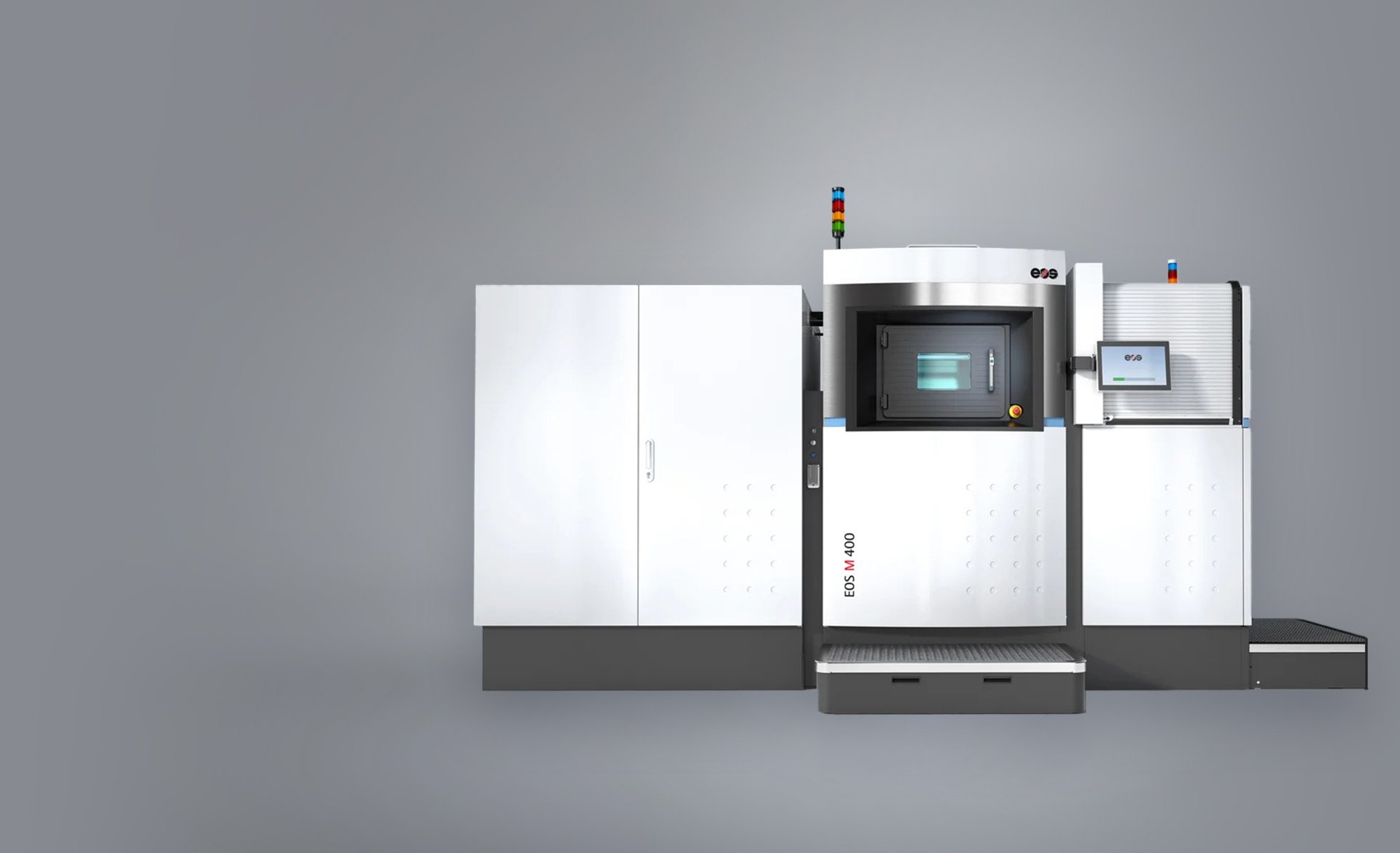
EOS M 400
Proven DMLS Quality for Industrial Production
Increased productivity thanks to 1000-watt laser power
Modular platform with process and set-up station
Build volume of 400 x 400 x 400 mm
Highly Productive System
1000-watt laser power increases productivity with higher build rates and thicker layers. Ideal for serial manufacturing of large metal parts.
Easy to Use
Coating both sides with powder material reduces production downtime. A circulating air filtering system with automatic cleaning means fewer filter changes and longer service life.
Broad Portfolio of Materials
A comprehensive collection of materials is available, from light metals to stainless steel, tool steels and super alloys.
Technical Data EOS M 400
- Construction Volume
- 400 x 400 x 400 mm (15.8 x 15.8 x 15.8 in) (height incl. build plate)
- Laser Type
- Yb-fiber laser; 1,000 W
- Precision Optics
- F-theta-lens
- Scan Speed
- up to 7.0 m/s (23 ft/s)
- Focus Diameter
- approx. 90 µm (0.0035 in)
- Power Supply
- 50 A
- Power Consumption
- max. 50,2 kW / typical 16,22 kW
- Compressed air supply
- 7,000 hPa; 20 m³/h (102 psi; 706 ft³/h)
- Machine Dimensions (W x D x H)
- 4,181 x 1,613 x 2,355 mm (164.6 x 63.5 x 92.7 in)
- Recommended Installation Space
- min. 6,500 x 6,000 x 3,300 mm (256 x 236 x 130 in)
- Weight
- approx. 4,635 kg (10,218 lb)
- Software
- EOSPRINT 2, EOSTATE, EOSCONNECT Core, EOSCONNECT MachinePark, EOSCONNECT MachinePark, Materialise Magics metal package and modules
Compatible materials
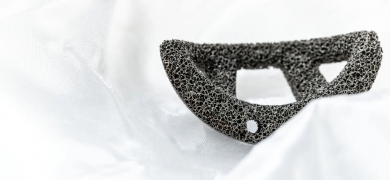 3D Printing in Medical Technology
Additive Manufacturing for Orthopedic Technology
EOS additive manufacturing technology creates precisely fitting instruments and implants directly from CAD data.
The process manufactures implants based on anatomical data collected from the wearer and allows them to be delivered quickly. This avoids any waiting times or complications due to extended periods of inactivity, so the implants fit better. It also speeds up the healing process as a whole and has a lasting positive impact on the patient’s quality of life.
More information → 3D Printing in Practice
Additive Manufacturing for Sports Articles
To remain competitive, the sports equipment industry is increasingly turning away from classically mass-produced items. With new ideas for product improvements, businesses are approaching their goal of optimizing “athletes and their equipment” as an integrated system.
More information →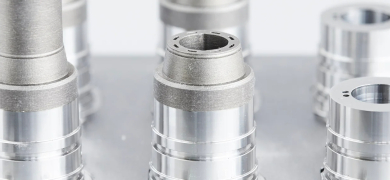 3D Printed Molds and Tools
Reduce Cycle Times, Increase Cost-Efficiency
Why using additive manufacturing to produce 3D printed molds and tools? As an industrial production method, the 3D printing process of additive manufacturing offers enormous design and manufacturing freedom. The most complex of shapes can be designed and produced in the highest quality, quickly and cost-efficiently, even for small batch sizes. In this way, the process provides a solution to a tooling challenge faced by many tool and mold makers:
In many industries, producing specialized tools and parts is one of the most resource-intensive manufacturing processes. Conventional processes are typically expensive, time-consuming and technically very challenging. The 3D printing process with EOS metal materials is the answer.
More information →